Experiment
Chicken Dumplings Gang
by admin on Oct.14, 2007, under Experiment, Food
I made an amazing chicken stew concoction based around the fairly meaty leftover carcass of a roast chicken. Part of the impetus was a confluence of remembering when my mother made us chicken and dumplings when I was a kid, looking for something different, and noting the dumpling recipe on the Bisquick box. Basically it was an excuse to try dumplings for the first time in decades and at the same time make efficient use of my 59 cent a pound roaster.
Essentially it was like making chicken soup, but I used potatoes and barley as I would in beef stew, not rice or noodles. I hope I can recreate it someday, because it was almost perfect.
The point of the post is to ask if anyone has thoughts on making dumplings without Bisquick, on optimally cooking them, and on storing them if any remain. We ate the majority of the stew and all nine dumplings. Well, two of us did. Sadie wouldn’t even taste hers, and Val only ate some because I spooned some into her and reminded her how much she’d loved the pre-meal tastes. We had an early supper so I can go do some stuff and everyone can just snack later.
I wasn’t sure if I should simply leave them in with the stew when I refrigerated it, or instead pull them out and store them apart.
Zucchini Fritters
by admin on Jul.30, 2007, under Experiment, Pointer, Recipe
I partially answered my own squash question, finding a ton of zucchini recipes online.
So when I turned off the computer in deference to thunderstorms yesterday afternoon, I started experimenting ahead of when I would otherwise have started making supper. I decided to try making zucchini fritters, using two of the five at the linked page.
I didn’t use any of these recipes, but I was intrigued by the pancakes, faux crab cakes, and Lucky Olive’s Zucchini ideas there. I don’t have any Old Bay seasoning, nor having I smelled or tasted it to my knowledge, so I’d have to wing it, combining the seasonings that are, in some proportion, a part of Old Bay. Which already sounds like something I’d come up with, except I seldom use the dry mustard in anything but Laurie’s Spicy Chicken (which I may as well repost here, if Google is going to have such an insanely hard time locating the post).
I also thought zucchini enchiladas sounded intriguing, though it intrigued me as much that it didn’t call for canned enchilada sauce, and could presumably be adapted to chicken, or a mix of chicken and veggie.
Anyway, I was mainly focused on the 4th fritter recipe, but I was intrigued by the 2nd one, as anything that calls for mint is so rare in my experience.
Here is the first recipe I used, as written, with points of concern in red:
3 cups of coarsely grated zucchini
2 large eggs, beaten
2 tablespoons of milk
2 teaspoons of all purpose flour
1 tablespoon of chopped fresh mint or
1 teaspoon of dried mint leavesPlace zucchini in colander; let drain 1 hour. In a large bowl, with a wire whisk, beat the eggs until they’re frothy. Add remaining ingredients; whisk until blended. Stir in the zucchini, 1/2 teaspoon salt and 1/4 teaspoon freshly ground pepper. Preheat oven to 200ºF. In large skillet, over medium to high heat, heat 2 tablespoons salad oil. Spoon in fritters batter, using 1 tablespoon butter for each fritter, adding more oil as necessary. Cook 1 minute on each side, until golden brown. Keep warm, covered with aluminum foil, on platter in oven until ready to serve. Makes 6 servings.
First annotation, the flour; this seems to be too little. My proportions were off because I used one cup of zucchini but used a whole rather large egg, but if you compare to the later recipe, the minimalist amount of flour makes little sense. They came out almost custardy, with kind of a soggy texture. The mint flavor went poorly. It would be better simply to steam, boil, even roast or bake zucchini with mint.
I grated one zucchini, resulting in 3 1/3 cups to use. As noted, I decided to use a cup for the mint variant, interpreting 2+ cups as about right for the garlic, oregano and parm variant. Though in reality what I grated was little more than a medium zucchini, so you could interpret the second recipe as saying to use five or six cups.
The grated zucchini went into a collander that nested into a bowl so it could shed liquid, and I mixed in a fair amount of salt to aid that process, letting it sit quite a while.
Anyway, I beat an egg, added and beat in maybe a tablespoon of milk, a teaspoon of flour, a couple dashes of black pepper, and near half a teaspoon of dried mint. Flour by the teaspoon? Still sounds weird to me. Then I mixed in the zucchini thoroughly.
I used olive oil for frying; not very deep. One lesson is they could have used more oil. That second annotation I realized, after momentary confusion, that it was a typo of batter. It’s not saying to add a tablespoon of butter for each fritter.
The modified recipe made four, nice and neat. They were thinner and runnier than the later ones, and I was surprised while they were still cooking as they seemed hesitant to get crispy. Getting Deb to eat zucchini is mainly about texture. That they came out like custard was no help, given that she disliked custard due to its texture.
You could eat them and live, but they were weird. I snacked down about one and a half, including a small piece I gave Sadie that sadly made her uninterested in trying the other kind later. She made a face and discarded it.
Not recommended. But I’d still love some ideas on what to make using mint, since I have a jar of it on the spice rack.
Here’s the recipe as written for the other fritter variety I tried:
2 medium zucchini, unpeeled & shredded
1 cup of flour
2 beaten eggs
Salt to taste
Pepper to taste
1 teaspoon of oregano
1 clove minced garlic
1/4 cup of water
1/4 cup of Parmesan cheeseCombine and mix all ingredients. Mixture will be the consistency of pancake batter. Drop by tablespoonfuls into hot oil and fry until golden brown. Drain on paper towels.
I had two cups and a fraction of shredded zucchini, as mentioned, and I decided to treat that as the quantity correct for the recipe. Who’s to say what “medium” means, after all.
The other ingredients followed along, except it was parmesan and romano, rather than straight parm, and I used a little extra, and the clove of garlic was fairly large. I also added a dribble of extra water when I couldn’t even mix the batter, it was so thick. I scoffed at the “consistency of pancake batter” part, but it was, for relatively thick values of pancake batter. The moisture in the zucchini saw to that.
I made the oil deeper for these, and they tended to be thicker. Used slightly higher heat and made sure they were cooked as crisp as could be expected.
Valerie ate three of the twelve the recipe made. Sadie didn’t try them.
I thought they were tasty, maybe a bit strong on the garlic, but strong as it was, the oregano flavor shone through too.
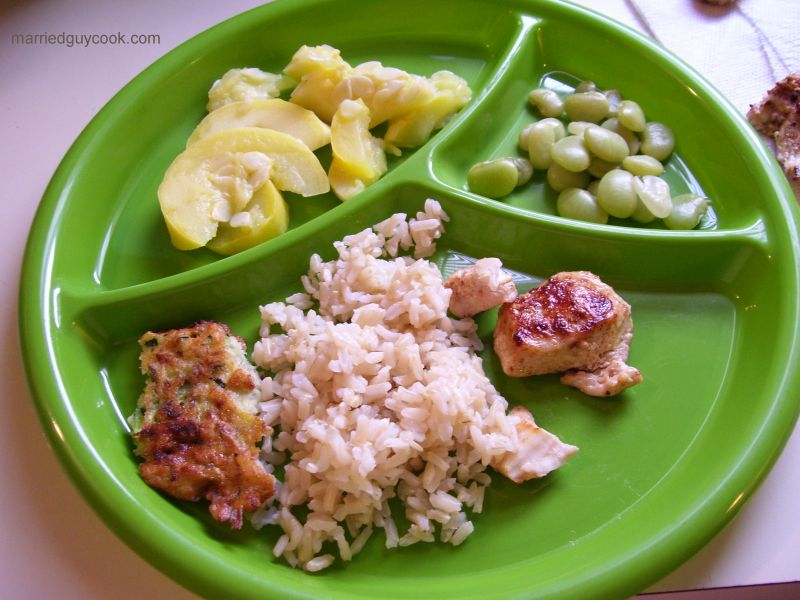
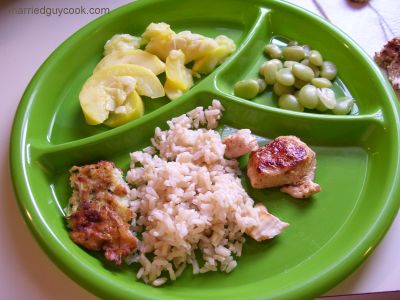
We ate all twelve before and during dinner, despite having chicken, rice, summer squash and lima beans too.
I cooked the chicken in the same oil, figuring the flavor infused from the fritters would be a good base. I added a touch of garlic powder, red pepper, generous paprika, dash of ginger, celery salt, pinch of oregano, and some Italian seasoning. It was one of the tastiest batches of random chicken I’ve ever made.
I keep forgetting; I have pictures.
Plate of food for one of the kids, including part of a fritter:
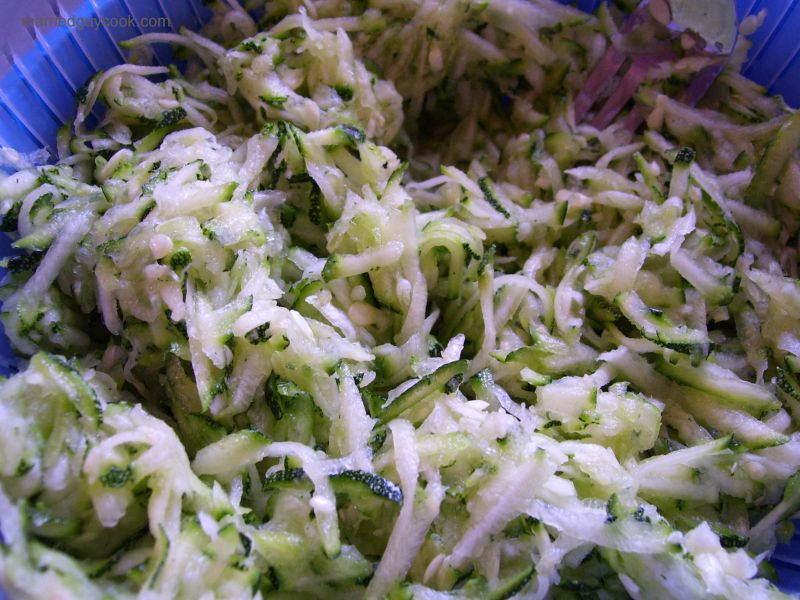
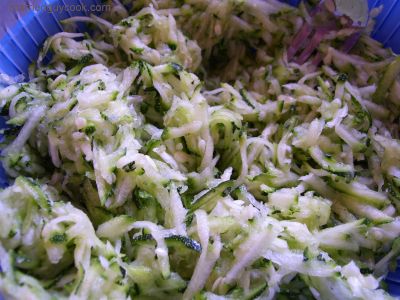
Shredded zucchini, ready for its closeup:
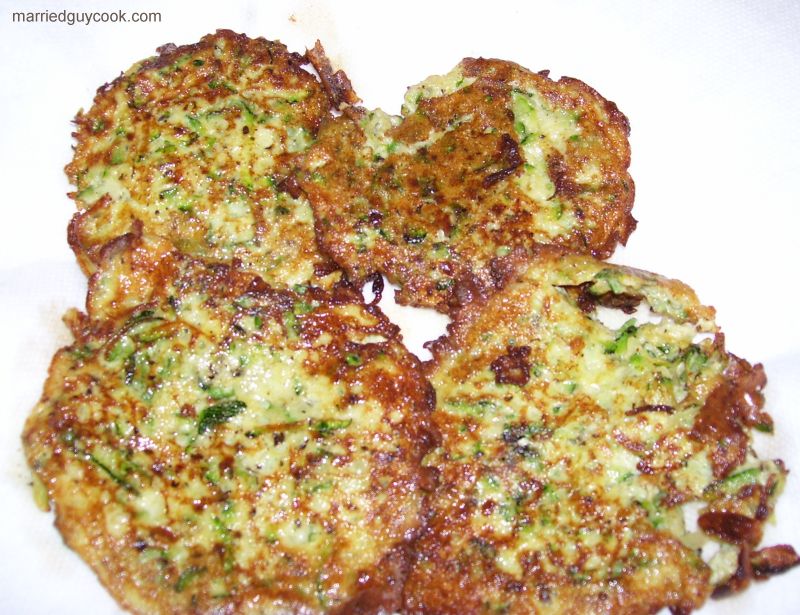
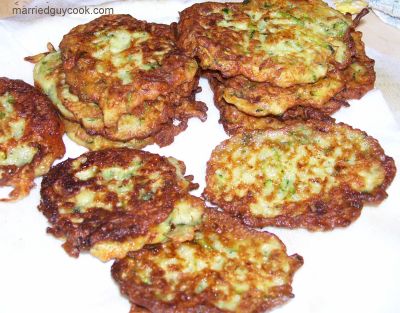
Mint zucchini fritters:
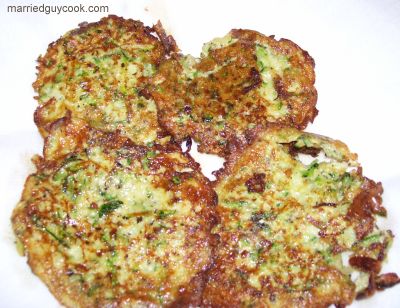
Garlic oregano parmesan zucchini fritters:
Laurie’s Chicken: Making It Measured
by admin on Jul.30, 2007, under Experiment, Food, Recipe, Repost
This is a repost of Laurie’s Chicken: Making It Measured from retired blog Accidental Verbosity. I’d have eventually reposted it anyway, but when I went searching for it today I found that Google had changed something about how AV is indexed or ranked that made traffic there plummet a couple weeks ago from just about 300 a day to under 100. Whatever that change was, it made this post not findable at all by title or most of the logical sets of keywords. I should probably start reposting systematically, but this is one of my favorites…
My stepsister used to make a hot red sauce baked on top of chicken breasts, usually as a treat for her less kitchen comfy cousin, and once for me when we were both at my father’s house in Vermont. It was so good, I always remembered it fondly and wanted the recipe.
My stepmother recently asked her about it, and here is the “recipe” as I received it:
1/3 cup ketchup, 1 TBLS W’shire Sauce, black and cayenne pepper to taste, dry mustard, Brown sugar (she said she sometimes used twin B. sugar) and a little apple cider vinegar. Says these are all the ingredients which as you can see its by taste. Cook until slightly reduced. I would think you could dble this as it does [not] make very much.
So I decided to attempt to measure and create a more detailed recipe, based on guesses and adjustments to quantities the first time I made it. Here is what I wrote up as a result, followed by pictures during and after. It is all quite adjustable, but if you like hot and don’t like lack of measurements to guide you, this works:
Laurie’s Chicken Recipe
This would work for 3 breasts, or heavy on 2 breasts. This is extremely hot as measured here, and could be done lighter on both kinds of pepper to soften the impact. Everything is somewhat flexible, beyond that, to taste.
1/2 cup ketchup
1.5 tablespoons Worcestershire sauce
1/4 teaspoon black pepper
1/2 teaspoon red cayenne pepper
1/4 teaspoon dry mustard
3 tablespoons brown sugar
1 tablespoon apple cider vinegar
2 tablespoons or so water, optional
boneless chicken breasts (2 or 3, adjust recipe to make more)
2 – 3 tablespoons butter, optional
Combine the spices, ketchup, worcestershire, brown sugar, and vinegar. I ended up using water to help flush as much as possible out of the measuring cup I mixed it all in, when transferring to a small saucepan. It gets cooked down either way. I was tasting as I went along, adding brown sugar after it was in the pan. Stir regularly while cooking over low heat.
Preheat oven. I would estimate 400 degrees throughout to be appropriate, though I started at 450. I put butter in an appropriately sized Pyrex pan and let it melt in the bottom before taking the pan back out. This was on the theory I needed something greasing the pan, and everything is better with butter. It would probably work fine with spray or even nothing.
Place the chicken in the baking pan. Cover top of each piece more or less evenly with sauce. Bake until done, perhaps 25 – 30 minutes at 400.
Here’s the sauce on the stove while cooking down:

Here’s the chicken after I put the sauce on, before baking:

Here’s a finished chicken breast:

I don’t know how, but Deb makes arguably the best mashed potatoes I have ever had. Normally I’m more of a baked guy. Some might even say I’m half-baked. Anyway, neither here nor there with respect to the recipe above, this is what Deb made to go perfectly with the hot chicken:

It was amazingly good; a bit on the hot side for Deb, perfect to bordering on excessive for me.
Barbecue Pork and Chicken in Mushroom Soup Gravy
by admin on Jul.21, 2007, under Experiment, Food
Last night I let Deb do the cooking; a particularly good batch of chicken broccoli alfrado. However, the two nights before that were particularly good ones for my “toss something together” experimentation that makes it impossible to convey recipes.
Two nights ago it was a barbecue shredded pork, but I had started it the night before, at the same time I worked on the chicken.
The first part was cooking it in the crockpot, with a twist. I used water, cider vinegar, a small handful of chopped onion, a generous sprinkle of red pepper flakes, and a wee bit of celery flakes. I forgot about the typical addition of brown sugar, then decided to pass when I remembered in time to have sweetened it up a little. Thing is, the sweet isn’t necessarily needed, and perhaps the onions added a subtle touch of sweetening.
That resulted in rather tasty boneless pork loin (there were four pieces, enough to exactly cover the bottom of a large crockpot without any being on top of the rest) with a distinct but not excessively strong peppery flavor. The pork from there would have been good any number of ways, including on a plain sandwich with some mustard.
It went in the fridge until the next evening, and tasted excellent cold.
Based on the flavor, I wanted whatever I did to lean sweeter rather than sharper or spicier. I considered a Chinese inspired sweet & sour type of sauce, shredding or chunking the meet as I would with barbecue, mixing it in and serving it over rice. I considered coming up with kind of a honey mustard sauce, which could presumably go on a sandwich or over rice. I considered coming up with a variant on what I’ve done for barbecue sauce before. That’s where I ended up, as it sounded easiest, tastiest, and fit the idea that for a change we’d just have sandwiches.
I made a concoction that included lots of brown suger (I believe it was 5 heaping tablespoons, and that was as close as I came to measuring anything), some vinegar, a packet of soy sauce (okay, that’s a measurement), more Worcestershire sauce than I normally use in anything, yellow mustard, ketchup, water, garlic powder, red pepper, and allspice. How good was it? I really, really wish I had a recipe. I whisked it smooth, simmered it, tasted and approved, and shredded the pork into it, stirring it in and letting the pork heat via the sauce.
I was shooting to have just enough sauce to coat the pork, with minimal extra to make it sloppy, and somehow succeeded, entirely by eye. There were no “good rolls” on hand, but we had some hot dog rolls in the freezer and employed them. The sauced pork went on the rolls with some cheddar cheese. On the side we ate chips, having an unusual, veggie-free meal.
Two nights ago I craved something along the lines of chicken in gravy over rice. Inspired by a comment by Jen, in which she described something akin to no peek chicken, but in a crockpot, I decided to use cream of mushroom soup in the gravy. I might have attempted something in the crockpot, faking out the onion soup part, but it was too late by the time I thought of that.
So I thawed three chicken breasts, of course, then cut them into small pieces. In the pan I melted some butter with various spices, emphasizing very heavily the crushed bay leaf. I also included amounts ranging from almost none to fairly substantial quantities of other things, including savory, thyme, poultry seasoning, garlic powder, ginger, red pepper, black pepper, celery flakes, oregano, and I believe both chives and parsley. Cooked the chicken until done and the extraneous liquid was largely cooked off, leaving just a bit of remaining butter/oil.
In the meantime, I had filled a Pyrex cup with water, heated it two minutes, then dropped two chicken boullion cubes in it to sit and dissolve.
Moved the chicken to one side of the pan, added a glop more butter, let it melt, whisked in a heaping tablespoon of flour, then another and some of the broth to smooth it out as it overthickens.
Rapidly add the rest of the broth and whisk it in. So far so good. At this point, depending on the dish and consistency, I might add more water, more flour, some sour cream, some milk, or even some flavoring if I tasted and it was lacking. I added a can of condensed cream of mushroom soup. It happened to be Wal-Mart’s store brand, which tasted a little different from Campbell’s, but seemed perfectly good. Mixed that in, along with enough more water for appropriate consistency and volume, and stirred the chicken in with the gravy.
The chicken itself had kind of a strong flavor, very oriented to the bay leaf, which I would probably reduce in the future. The gravy was fantastic, with plenty of chicken flavor, yet different, and with little bits of mushroom in it. The peas I served on the side could have gone in it.
I make a meal that size and we always have leftovers. If not of the rice or peas, at least of the meat dish. Not this time.
The kids devoured the chicken. Even Valerie, who eats meat minimally compared to her love of veggies. I gave them each about six piece of chicken, in gravy beside and over a small pile of rice. They each had seconds of probably as much again, Sadie had thirds, and they did a good job on the rice and peas too. The two of us ate heartily, and I finished it when I saw how little would be left. It was particularly good.
It helps that the kids seem to have gotten more in tune with meals, eating more at meal times and snacking less. It also helps to give them an advance taste. That’s a great trick, if you want your kids to be more enthusiastic about what you’re serving. Valerie had an intrigued look I’ve never seen before when I gave her a taste of the gravy when it was almost done. She got a second taste that included chicken, and Sadie got a couple tastes as well. They both liked it enough to be primed for it to appear on the table.
Another trick that can work well to get them to eat well is sort of a “dessert first” serving of a small sweet, or a small snack, shortly before the meal. An M&M or spice drop before dinner tends to make them devour the “real food.”
Fruity Pancakes
by admin on Jul.18, 2007, under Experiment, Food, Recipe
Yesterday at lunch time Sadie happened to see me heft the big Bisquick box by way of reminding myself that, yep, it was almost empty and we’d forgotten to buy more. It was one of the things I forgot on the BJ’s run.
That resulted in a chorus of “pancakes! pancakes! daddy make pancakes!”
I looked in the fridge and confirmed we were out of blueberries, which I pictured finishing in a half batch of pancakes for the kids.
Aha! I had an idea.
We have a big bag of BJ’s own brand of trail mix, a particularly fruity variety. It has some almonds and soy beans, and pretends to have a walnut piece here and there, but mainly it has apricot bits, raisins, cranberries, blueberries and cherries. It’s almost too sweet.
I heated a half cup or so of water in a Pyrex cup for 99 seconds in the microwave.
Into the hot water I put a large amount of dried fruit to soften and rehydrate a bit. Never thought of this before, but it’s a great trick for making fruit pancakes without requiring a relevant kind of fresh fruit in the house. Then again, even though they can be made with other kinds, to me the fruit for pancakes is blueberries or bananas. Thus having apples and nectarines on hand was beside the point.
The fruit soaked several minutes. I found there was around a cup and a third or so left in the box, so I finished it, using the Bisquick pancake recipe as if it were the full two cups. Figured the fruit would bulk it up, and a high proportion of egg would help it rise around the fruit as it cooked.
I scooped in the fruit, sans most of the water, and added a handful of sunflower seeds to make it more interesting.
I poured out larger pancakes than usual, doing two on the pan at a time, rather than four. The fruit was heavy and wanted to cluster enough that it was basically a matter of pouring out some batter and then scooping fruit onto it, trying to keep the amount in each appropriate. Otherwise it was just like cooking any old pancakes.
They were fantastic, able to be eaten without syrup, or with minimal syrup. It was a little like having a fruitcake flavored pancake, but not exactly.
Sadie devoured a full two good-sized pancakes. Valerie ate most of one avidly, and overall might have eaten as much as one and a half. They didn’t eat this much when we had blueberry pancakes. I ate the other six.
Definitely a keeper idea, and brilliant given our tendency to have trail mix or raisins in the house. We actually prefer Wal-Mart’s house brand large bags of tropical trail mix to the fruity one from BJ’s, but the fruity one was probably better for this.
Drumstick Rub and Grill Experiment
by admin on Jul.07, 2007, under Experiment, Food, Recipe
For the drumsticks I decided to try something based fairly closely on this rub recipe. The source recipe being based around a cup of paprika, resulting in three cups of end product, meant adjusting it down in a big way. I jotted down the ingredients in proportions rather than measures, like this:
1 Paprika
.5 Chili powder
.5 Cumin
1/48 Black pepper
And so forth.
My approximate measure mixed together thoroughly were:
1 Tablespoon Paprika
1/2 Tablespoon Chili Powder
1/3 Tablespoon (which is a lot like a teaspoon, eh?) Cumin
1/4 Tablespoon or less Black Pepper
A couple dashes Red Pepper
1/4 Cup Brown Sugar (rather than white)
1/8 Tablespoon Thyme
1/8 Tablespoon Garlic Powder
1/8 Tablespoon or less Onion Powder
A few dashes Salt
Dash of Allspice
Pinch of Savory
The last two ingredients are additions. Brown sugar is a substitution. based on my experience using it in similar stuff. For what it’s worth, I didn’t have trouble with the sugar burning on the grill, though I read in recipes that lacked it a warning not to use it for the grill for that reason.
A few hours before we went to the BYOM (bring your own meat) cookout, I made the rub, coated the seven drumsticks well, including under a large bit of detached skin, put them in a sealable plastic bag, tossed in much of the rest of the rub, and shook it to coat them even more. That went in the refrigerator for a few hours, then into the well-iced cooler for what turned out to be a few hours more.
I knew we would never eat them all, but wanted to let other people try them, especially if they turned out good.
I cooked them quite a while on the gas grill, turning them over a couple times. Depending where they were, they ranged from apparently cooked to falling off the bone.
The first one I tried tasted too peppery, and also seemed suspiciously underdone. It was probably fine; just not falling apart as I like. The second one I tried was quite good, but I would change the recipe. Meaning I’d do what felt right, as I usually do, rather than close to what a recipe said to do.
The third one I ate was also tasty. My nephew tried one and approved. Enough so that he ate three more, finally encountering an over-peppered one on his last drumstick and seeing what I meant about that first one.
Mostly, though, a success.
What would I do if I were trying this again? Less pepper and paprika. Possibly more, and additional, poultry seasonings. Possibly more of something like allspice or ginger. Perhaps more lightly applied rub.
I once did a chicken rub centered around orange (I’m amazed I found the recipe so readily to link it). Something like that might be interesting on a grill. Heck, I baked it, but the section has a focus on barbecues and grilling, so yeah. Heck, had I thought of it sooner, I even have oranges in the house because Sadie was with me at the farm stand and wanted them. And I have cloves, which I don’t believe I did when I made that rub before. Even if I do have to grind them myself.
Anyway, that’s the result. I didn’t think of taking pictures, though I could have as we had the camera. Oh well.
Pancakes
by admin on Jun.29, 2007, under Experiment, Food
For lunch today I made blueberry pancakes at Sadie’s request. She’d never had them, but was intrigued by the blueberry pancakes in a Curious George book. The kids absolutely adored them, and they were right to do so. That was half or so of the batter, matched to the amount of blueberries remaining from a recently on sale pint the kids had been enjoying.
While I was at it, I used strawberry pieces in some of the batter, for strawberry pancakes, which are something I don’t recall ever having or hearing of before, though I could be mistaken.
The last of the batter made four plain pancakes.
This is intended in large part to be an audience participation post, and it occurs to me it goes beyond what fruits or other things you might have tried in pancakes, to the very stuff of pancakes themselves.
We buy industrial size boxes of Bisquick at BJ’s and have them around for months to use when the need arises, for pancakes or otherwise. I tend to add far more milk and often more egg than called for by the box recipe, but otherwise it’s that simple and they are pretty yummy. Sometimes we have corn pancakes, made from small boxes of Jiffy corn muffin mix, also quite yummy. I haven’t tried making pancakes from scratch, but surely it’d be no big deal. Ironically, I have made crepes from scratch; similar enough. My father has at times made excellent pancakes out of a grainy mix that he further embellished. How about you; box, scratch, something unusual?
The most common fruit pancakes I’ve made, or had as a kid, are banana. Blueberry would have to be next. We had wild blueberries right around the house so in season there would be no shortage, Ditto for both wild and cultivated strawberries, which is why I am intrigued that I don’t recall strawberry pancakes. They were good today. I believe I’ve had peaches in pancakes. Not sure what else. Do you have a preferred addition to your pancakes, or something you tried that may or may not have been such a good idea?
I found myself wondering why we don’t eat them more often, apart from wanting to sleep afterward. We were low enough on syrup, I also used some boysenberry jam on some of mine, and shared it with the kids. That was good! Brings back memories of boysenberry syrup at IHOP when I was a kid.
What do you put on your pancakes? Real maple syrup? Fake or sugar free syrup? Other syrup flavors? Jam? Butter? Something else? Cold or warmed syrup?
Look at how something so simple as pancakes can turn into such a variable culinary delight.
Barbecue Shredded Pork Experiment
by admin on Jun.22, 2007, under Experiment
Wednesday I decided to try making up a barbecue shredded pork dish, not following a specific recipe, starting similarly to my barbecue shredded beef.
I had two pounds of boneless pork loin steak that had been on sale for $1.29/lb and was due either to be used or frozen. In the crockput I put a cup of water, just over an eight cup of cider vinegar, and about a quarter cup of brown sugar. I added the pork, cut into large chunks, with the worst fat removed but not a lot of effort made along those lines. I set the crockpot for the 4 hours on high setting and went to do things.
After three hours or so, I tossed in some celery flakes and pepper flake. I’d guess it was a teaspoon or so of each. It was nice to make something in which the pepper flakes fit logically, and it gave me a chance to see what they were like essentially rehydrated and cooked, as opposed to the more common use, in which I don’t partake, sprinkling them on pizza. Which isn’t as bad as pouring salt on your pizza, as my cousin used to do, before it turned out he had a funky heart problem for which low salt was legitimately helpful.
After the four hours was well over and it was sitting there on the automatic warm cycle, I scooped out the meat and shredded it, which meant touching it with minimal force and watching it fall apart. I put the liquid aside, except enough to cover the bottom of the crockpot.
I added a quarter cupt of honey to the crockpot before I shredded the pork. Timing probably doesn’t matter.
I added back the pork and ended up adding back all the liquid, but your mileage may vary, and it turned out more watery than it seemed it would.
I used dry mustard, ketchup, more vinegar, a little red pepper, a little onion powder, a little black pepper, and more brown sugar. This is subject to taste and to varying, and the flavor changes as it sits. I started with 1/2 cup of ketchup and ended up with a total of 3/4 cup or more. Brown sugar was probably 1/4 cup, maybe less. Vinegar was maybe a tablespoon. Dry mustard, the main source of heat, was perhaps as much as 1/2 tablespoon, but no more. The other spices we’re talking a dash or two or three.
It came out sweet, with clear overtones of honey flavor, with a tang. It was very different, but delicious. I’ll change it up next time, which Deb is eager for, and see if I can make it even better.
I had bought rolls at the farmstand, but we still had French bread needing to be finished. The rolls went in the freezer. We served the shredded pork on slices of French bread, with some cheddar cheese on top, and ate it with forks rather than as sandwiches. On the side we had corn on the cob, which I can no longer buy three ears of at a time, as the kids need a full ear each.
It is worth noting that after cooking in the crockpot with the vinegar, water, brown sugar, and addition of celery and pepper near the end, the pork was fantastic and would have made yummy sandwiches with no further ingredients added. Or it could have been served as a meat dish with sides, rather than on bread.
I could also see cooking up the meat to where it shreds, then adding a commercial barbecue sauce for convenience. No spices or guessing needed.
As usual, I took some pictures. As usual, they are on the camera as yet.
Pita Pocket Bread and Hummus Experiments
by admin on Jun.20, 2007, under Experiment, Pictures, Pointer
So I experimented making two related foods: pita bread and hummus. The recipes linked are what I followed most closely, though I tend to do a survey of various recipes for a given item and get a feel for what they involve and have in common, and what might make good variants. It is worth noting that Triticale has an interesting hummus recipe that goes into the many possible variations.
Pictures are at the end of the post.
Pita is basically just one of the many forms of flatbread that seem common in wide swaths of the world. You start to see what the differences and commonalities are, but whether it’s made with lard and salt water, milk and yeast, water and yeast, in the oven or on a pan, coated with egg yolk, clarified butter, oil, or nothing, it all starts with some form of flour and results in a more or less flat result that can be used to wrap or pick up food. Pita pocket bread is different in that it’s commonly encouraged to puff up so there is a pocket when you’re done. Perhaps it will work that way for me next time.
The result tasted awesome. We learned it does not keep long out in a zipper bag in the kitchen in summer. Next time, we refrigerate, as you do with flour tortillas.
We had them with the hummus, but more so with butter, peanut butter, or honey. I even tried a little straight tahini on a pita chip. Tahini is essentially natural “peanut butter” made out of sesame seeds; sesame butter, if you will. It has a nutty flavor, and will make your mouth stick together worse than any peanut butter I ever tried. I’m convinced it mainly needs to be used in other foods, or with something else; perhaps tahini plus honey on a cracker or bread, for instance.
The dough turned out way too sticky. To work with the stuff at all, the rolled out dough was thick with flour on the outside. They were baked that way and it looked funny. This recipe called oil in the bowl in which the dough rises, such that the whole thing has a coating. Other recipes called for brushing a little oil on the rolled out pita before it baked. Afghanistan’s variant of flat bread is essentially the same as pita bread, but you score it and brush it with egg yolk before baking.
So, next time the dough gets more flour or less water in it to keep it from being so sticky, and I’d be inclined to brush them with olive oil before baking.
Also, the oven needs to have more time than I gave it to warm up, and the higher the temperature, the better. The recipe says 500. I ended up at 550, and it’s apparently traditional to do them in ovens that can be more like 700. The first batch was cooked, but just.
I did get some puffing. Any degree to which I was able or bothered to turn any of the result into pockets required a knife to insist that they open.
They were just plain tasty. The kids loved them. They also made pretty good chips. I cut one into little triangles and used top brown in the toaster oven to crisp them. That worked perfectly.
They were kind of a pain in some ways, but overall pretty easy.
Hummus is basically cooked, ground up chick peas, also called garbanzo beans, with some other stuff, most notably tahini. Most of the time you are using lemon juice, and I wish I’d had fresh. They also call for garlic. All the recipes I’ve seen call for canned beans, and I can see where that would be convenient. I just happened to have dry beans.
I used have the 16 oz package, quick soaking them as I would pinto beans. That is, put them in a pan of water, bring it to a boil, then immediately turn it off, let them soak and hour or more, then drain, add fresh water, and cook.
I used two cloves of chopped garlic. That was too much, without having used more lemon juice or something else to balance it.
When the beans are ready, you’re basically running them through a blender or food processor to turn them and the other ingredients into dip-like paste. I used the cooking water from the beans as needed when it was too thick.
I departed from the recipe by adding a little red pepper and cumin from the spice cabinet. I also goofed and forgot to add the olive oil, which I should have remembered after looking at a variety of hummus recipes. It does work as an addition when serving, but the hummus would have been better with it added. Finally, I see it says to grind the chick peas, cool them, then add the rest. Oops. I was only half paying attention to the recipe.
Frankly, I am more interested in making pita bread again than in making hummus again, but Deb enjoyed it enough that it might be worth an experiment… with real lemon and more of it this time, and some other adjustments. The pita bread is just a nice variant to have for sandwich-like usage, it doesn’t need the hummus as an excuse. Plus the kids loved the bread and hated the hummus, and there’s pretty much nothing they don’t eat.
Okay, here are the pictures. First, the beans cooking:
Hummus in the blender. I started with the food processor but it was both too small to hold it all at once, and surprisingly ineffective at complete and consistent choppage:
Hummus as served in a bowl, with a little olive oil and red pepper added:
Now the pitas, starting with the dough, still there despite having risen:
The dough after splitting it up. I made 13 of these, but might have been better to make no more than 10 and roll them a bit thicker:
Uncooked pita dough, rolled and ready for the oven:
Pitas on the cookie sheet:
Stack of cooked pitas:
Pita chips:
Chili and Refried Beans
by admin on Jun.15, 2007, under Experiment, Food, Pictures, Pointer, Recipe
Sharon has what sounds like a tasty and easy chili recipe, complete with actual measurements. I notice it doesn’t call for chili powder, but you’ll note that it includes all the components of chili powder: cumin, cayenne pepper, garlic and oregano. I also love cornbread with chili. Her post and the cold weather inspired me to make some last night, even if it is nontraditional with pasta and red sauce. The kids just love it, until they get full and merely turn it into tiny crumbs.
I made my version of chili the other day and meant to write about it, so I thought it was funny we were doing unplanned chili synchronization between households.
First a bit about history.
Once upon a time, I used to make what I call faux chili based on cheap cans of Campbell’s Pork & Beans. Which isn’t so odd, in that they are pinto beans in a tomato-based sauce, and chili seems to be made normally with pinto and/or kidney beans. I considered it both tasty and part of eating cheap, which will be the topic of another post Real Soon Now. Let’s just say I didn’t know from eating cheap, and didn’t know at the time that cans of those beans on sale 3 or 4 to a dollar was not that cheap.
Back then, I’d cook up some pepper and onion if I had it, ground beef, toss in beans, season it mainly with chili powder, add some ketchup and a squirt of yellow mustard, add sugar or brown sugar as needed, and serve it to myself for 2 or 3 big meals. It was quite good. I believe I also used tomato paste at least sometimes.
Lately I’ve discovered the joys of dry beans, taking it back closer to scratch and being really cheap. When I knew I was spending my last cash for probably a couple weeks on stocking up groceries last week (except a little reserved for milk and a few other run-outs), knowing the rate we’d been using them and comparing the unit price, I bought a 64 oz. bag of pinto beans instead of the customary one or two 16 oz bags.
Dry beans require planning. You can’t get to 5:00 or 6:00 and say “hey, let’s have beans!” We put them in a pot of water, bring it to a boil, then turn them off and let the gassiness soak out of the beans for an hour or more before draining them and adding fresh water for the actual cooking.
At that point you have beans on their way to ready for whatever you mean to make. Heck, you could serve just beans with some butter, salt and pepper on them, the way my father loves shell beans. When I set out to make chili, I wasn’t sure if it would be truly ready on time, and even if so, we would also want refried beans around in the next couple days for burritos.
I cooked 16 oz. of beans, 2 cups dry, and when they were cooked enough, I took two cups or so wet out of the pan, and some of the water as needed, for refried beans.
For the refried beans, I actually used a medium sauce pan. I threw in a generous chunk of butter (probably 3 tablespoons), cooked a handful of chopped fresh garlic, onion and green pepper, all of which are optional or could be replaced with dry seasonings. All you really need is beans, if you want nothing more than their yummy flavor. What I missed is an effective masher, and I’d not cooked the beans to the point of mush before splitting them for refried and chili.
When the flavoring veggies were cooked right (transluscent onions, for instance), I threw in the beans, did a lot of smooshing and stirring as best I could, adding liquid as needed to keep them from being too stiff and dry to work with or to cook without burning. I also added I forget what else, but mainly cumin, not a lot, and possibly some red pepper, cilantro or oregano. The beans came out tasting mostly like beans, to give some idea; more enhanced than flavored. They were absolutely fantastic and got raves. We did indeed have burritos that night and let the chili simmer longer. It was interesting making two suppers at once, but a huge treat not cooking the second day.
The stiff texture of the beans made me picture making sandwiches based on them. I figured mix a small amount of finely shredded meat in with them, maybe use meat broth to imbue them with meat flavor, and there you’d have a serious meat stretcher or substitute. Which means I just reinvented the idea of falafel, sort of.
Back to the chili…
My new favorite thing to do is make chili not with expensive ground beef, but with the cheapest on sale beef, like top round for London broil at $1.69 or whatever. By comparison, I recently bought 90% ground beef and by buying it in a 6.67 lb package at BJ’s got the remarkably low price of $2.29. Chili would be fine with the fattier ground beef, fortunately, but we normally buy and freeze one kind and use as needed, rather than running to the store specifically for a variant for a meal we decided to make.
I cut the beef into small chunks and add it to a frying pan with, optionally, stuff like chopped garlic, pepper and onion. I add spices to it, or to the butter before it goes in, including but not always celery flakes, cilantro, red pepper, black pepper, paprika, allspice, ginger, cumin, oregano, and chili powder. Without the real versions added, that would include garlic and onion. I basically stir regularly and cook until done, letting some of the juice cook off but keeping some.
If I ever remember, I will probably throw a small amount of vinegar in with the meat not long after it starts cooking.
In the meantime, I’ve thrown some chili powder and maybe other spices into the beans. Tomato-based stuff can go in before or after the meat. I normally use tomato paste, as small can, and ketchup, using more as needed later to adjust the flavor. Diced tomato, tomato soup, or whatever would work, depending what you have and what you like. The beauty of chili is it’s highly variable and a matter of taste.
A little vinegar can be good, giving it added tang, especially if you are not using ketchup, or have too little ketchup on hand. I keep forgetting until the chili is well underway, and then this time I added too much. The small dribble turned into a good sized glug. It didn’t ruin the chili, but it added more tang than I planned and needed to cook and soak in far longer to balance the flavor.
After everything is mixed together, it’s just cook, stir, taste, adjust as needed. I normally throw in a not insignificant amount of brown and/or white sugar. I normally add more chili powder at least once, and perhaps other spices depending how strong the flavor seems. If you get it too spicy, it remains too spicy, but at least sugar tends to ease the bite.
What amounts to no more than 3/4 of a 16 oz. bag of beans and no more than 2 lbs of beef makes us two good meals. It can be served with shredded cheese, a dab of sour cream, tortilla chips, bread and butter, or corn bread as mentioned earlier. It can be made thinner or thicker. It can be made in greater or lesser proportions of beef to beans. It can be made hotter or milder. Whatever I start with, mine tends to come out in a particular taste range, frankly almost identical to the taste I used to achieve starting with Campbell’s beans and owning a smaller variety of spices. I haven’t tried it on hot dogs yet…
I actually have pictures off the camera in time to use them in the actual post. Some orphan pictures should follow today in their own post. I had some fun with raw ingredient or cooking stage pictures this time around, just plain trying to get interesting pictures.
Partially cooked and then mostly done refried beans:
The chili, done or near the end: